Kashmir
World War ZKashi is presented as one of the outbreak’s most important overland migration hubs, a remote destination transformed into a center of clandestine movement. Its significance lies not in a single battle or political decision, but in the way it exposes how disease, money, state corruption, and human flight converged along an existing cross-border infrastructure.
A Border City Before the Outbreak
Before the outbreak, overland smuggling through Kashi was comparatively unattractive. Arranging passports, counterfeit tour buses, contacts, and protection on the far side required substantial money, while the most lucrative established routes ran toward Thailand or Myanmar. For people leaving Kashi itself, the principal alternative led into the former Soviet republics, destinations so unpopular that Nury Televaldi did not initially identify as a shetou. He described himself instead as an importer dealing in raw opium, uncut diamonds, and human cargo, including girls and boys, whatever could be sold at a profit.
The outbreak altered the value of Kashi’s position almost overnight. Televaldi recalled that he had once operated from Kashi and that an outbreak had occurred there, although the government suppressed news of it quickly. Rumors circulated before reliable public acknowledgment, and people understood that something was wrong even when official information remained absent. The city’s preexisting connections to Central Asia therefore became the foundation for a new and vastly larger business: moving people who no longer cared where they went, provided they could get out.
The Boom in Westbound Flight
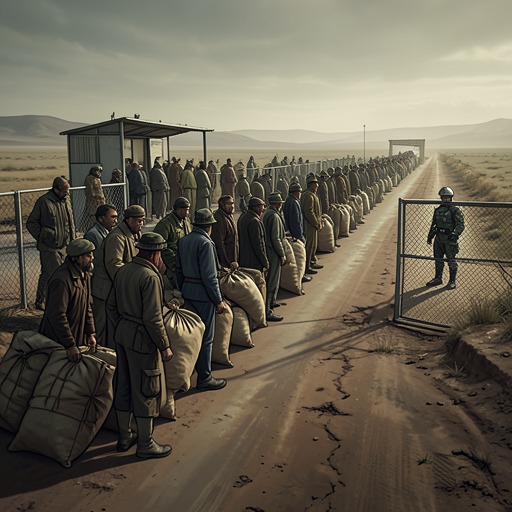
Kashi became a boomtown for migration. Televaldi estimated that ninety percent, perhaps more, of all westbound overland traffic passed through the city, with a small remainder traveling by air. His own air operations were limited to occasional cargo flights to Kazakhstan or Russia, but the eastern provinces developed a much larger aviation-smuggling economy. Wealthier clients purchased prebooked travel packages and first-class tourist visas, arrived in London, Rome, or San Francisco, checked into hotels, spent a day sightseeing, and then disappeared into illegal residence or onward movement.
The distinction between clandestine migrants and respectable society quickly broke down. Televaldi said his clients included members of the liudong renkou as well as urban professionals, private farmers, and low-level government officials. These people were not united by destination or ideology; they were united by what they believed they stood to lose. Their willingness to pay made the routes profitable, while the city’s position turned Kashi into a staging ground between a concealed crisis in China and the wider world.
Routes, Corruption, and Infection
The land routes through Central Asia were sustained by weak institutions and bribery. Officials in economically devastated countries sometimes assisted the smugglers with paperwork in exchange for a percentage of the fee. Televaldi’s task was practical and transactional: secure stamped documents, tag vehicles, pay guards, and collect his cut. Other smugglers helped carry people across the former Soviet republics toward India, Russia, or Iran, although he claimed not to ask where the passengers ultimately went. Kashi’s border economy thus depended on cooperation among smugglers, guards, police, bureaucrats, and officials who converted sovereignty into a purchasable service.
At first, relatively few infected people appeared on the overland routes. The blight moved too quickly for most travelers to remain functional during the journey: reaching Kashi could take weeks, while even the slowest infections reportedly lasted only a few days before reanimation. Infected clients commonly reanimated somewhere on the road, where local police recognized and collected them. As infestations multiplied and police forces became overwhelmed, however, infected travelers became increasingly visible along Televaldi’s routes.
Families attempted to conceal newly reanimated relatives rather than abandon them. Televaldi described bound and gagged bodies moving beneath clothing or heavy blankets in the backs of cars, banging from vehicle boots, and later being transported in crates with airholes built into the rear of vans. The airholes became an image of confused care: relatives understood that something terrible had happened to someone they loved, but did not yet understand the nature of the dead or the danger they carried.
Kashi in the Global Contagion Network
Kashi’s role was part of a broader system in which movement itself became a mechanism of transmission. Air smugglers rejected travelers showing advanced infection, not from humanitarian concern but to protect their business and evade foreign immigration officials. The governing rule was that a client had to deceive the smuggler before attempting to deceive border control, appearing healthy and behaving normally while racing against the disease’s progression. The later Flight 575 incident made the danger more visible, but the routes had already been established.
The outbreak’s international spread was also linked to systems other than immigration. In the early stages, infected organs may have been removed from people who were newly infected or had recently died, packed in ice, and flown abroad. The account connects China’s prewar organ trade, including organs taken from executed political prisoners, with the possibility that infected kidneys, corneas, pituitary glands, blood, eggs, and sperm entered international markets. Kashi is not identified as the sole source of this transmission, but its position in the same circulation of people and commodities helps place the city inside a much larger system through which infection crossed borders.
Narrative and Historical Significance
Kashi condenses the book’s recurring contrast between official silence and unofficial knowledge. Authorities suppressed reports of an outbreak there, while residents, smugglers, migrants, and border officials responded to rumors before governments publicly admitted the scale of the crisis. The city’s transformation from an inconvenient smuggling point into a boomtown shows how catastrophe can reverse the economic meaning of geography: a marginal route becomes the preferred corridor when established borders turn into traps.
Its importance is also demographic and political. The people passing through Kashi were not simply anonymous criminals or helpless refugees; they included workers, families, professionals, farmers, and officials who had different resources but shared the urgent need to escape. Their movement helped spread both the social consequences and the biological danger of the outbreak. Kashi therefore functions as a connective node in the global history of the crisis, where local concealment, commercial ingenuity, institutional corruption, and mass displacement combine to make the disaster impossible to contain.